Strategy · Persistent multiplayer
Nukestorm
Grow a colony. Feed it, arm it, and spend it on everyone else.
- In development
- Browser
- Multiplayer
What it is
A persistent war game you play in a browser tab, against everyone else playing it.
You run one colony. Its population is the engine that drives everything else — it produces food, it produces the industrial and technological units that buy missiles and research, and it is the pool your army is drafted from. Four numbers on the Control Panel decide how it is all divided, and they are the whole of your economic strategy.
Every sixty seconds a turn ticks for every colony in the game at once. Your population grows, food and units are produced, recruits are conscripted, everyone is fed, and morale recovers — in that order. The order matters: the population that grows this turn is the same population that gets taxed for recruits and then has to be fed. Get the balance wrong and people starve, and starvation takes your army with it.
What you build it all for is the Threats screen, which lists the other colonies close enough to your own size to be worth attacking. You soften a target with missiles, send the army in, take prisoners, and put them to work. Everything you can find out about a rival beyond their rough size has to be stolen.
In the game
-
One turn a minute
The tick runs for the whole game at once, so you are never waiting on your own clock. Growth continues whether the tab is open or not.
-
Four numbers
Agriculture, industry and technology are shares of your population that cannot exceed 100 between them, and conscription taxes it every turn. Every point moved into one is a point out of another.
-
Growth fights you
The growth rate is set by how many digits your population has, so it steps down as you succeed. A colony of 9,999,999 grows at twice the rate of one at 10,000,000.
-
Ten warheads
From the Owl, at one industrial unit for a hundred damage, up to the Nukestorm at a hundred thousand for fifty million. Every step up buys more damage per unit, so industry itself is a weapon.
-
A research tree
Five economic and military lines bought with technological units, permanently. Cruise missiles gate chemical weapons, which gate nuclear ones.
-
Morale as a rate limit
Each ground assault costs ten morale and it recovers ten a turn, so you get roughly one assault per turn indefinitely — or a burst of ten and then a long silence.
-
Fair fights only
You can only attack colonies in your own population band. It stops giants farming newcomers, and it cuts both ways: grow too fast and your rivals climb out of reach.
-
Espionage
The server never tells you a rival's exact numbers — only an order of magnitude. Scouts, Infiltrators, Spies, Double Agents and Moles are how you learn more, and only a Mole brings back their combat ratings.
The server never tells you a rival's exact population or army. It sends the order of magnitude and nothing more.
Screens
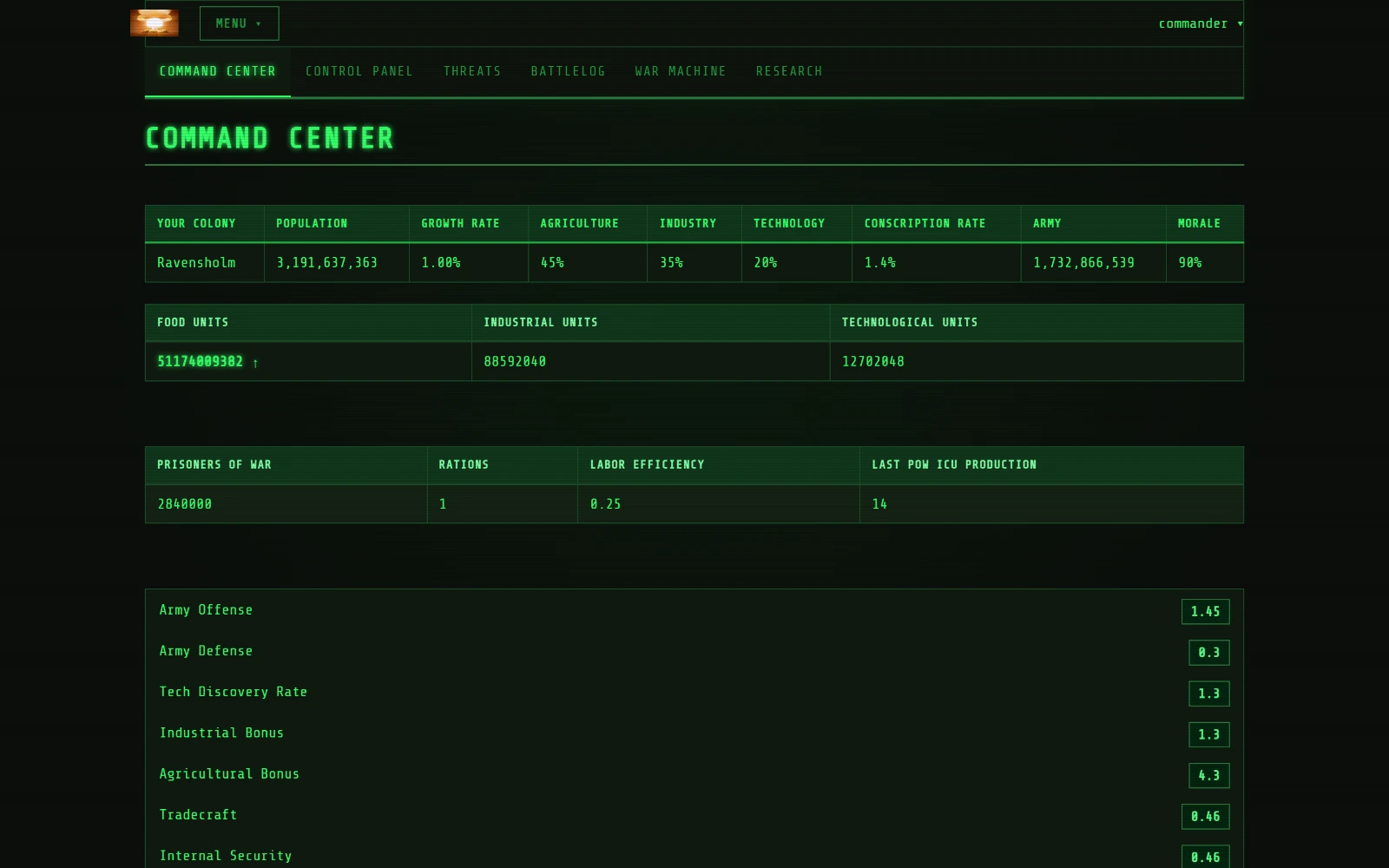
The Command Center. The whole colony in one readout — the four numbers you set, the stockpiles they produce, and every bonus research has bought you. 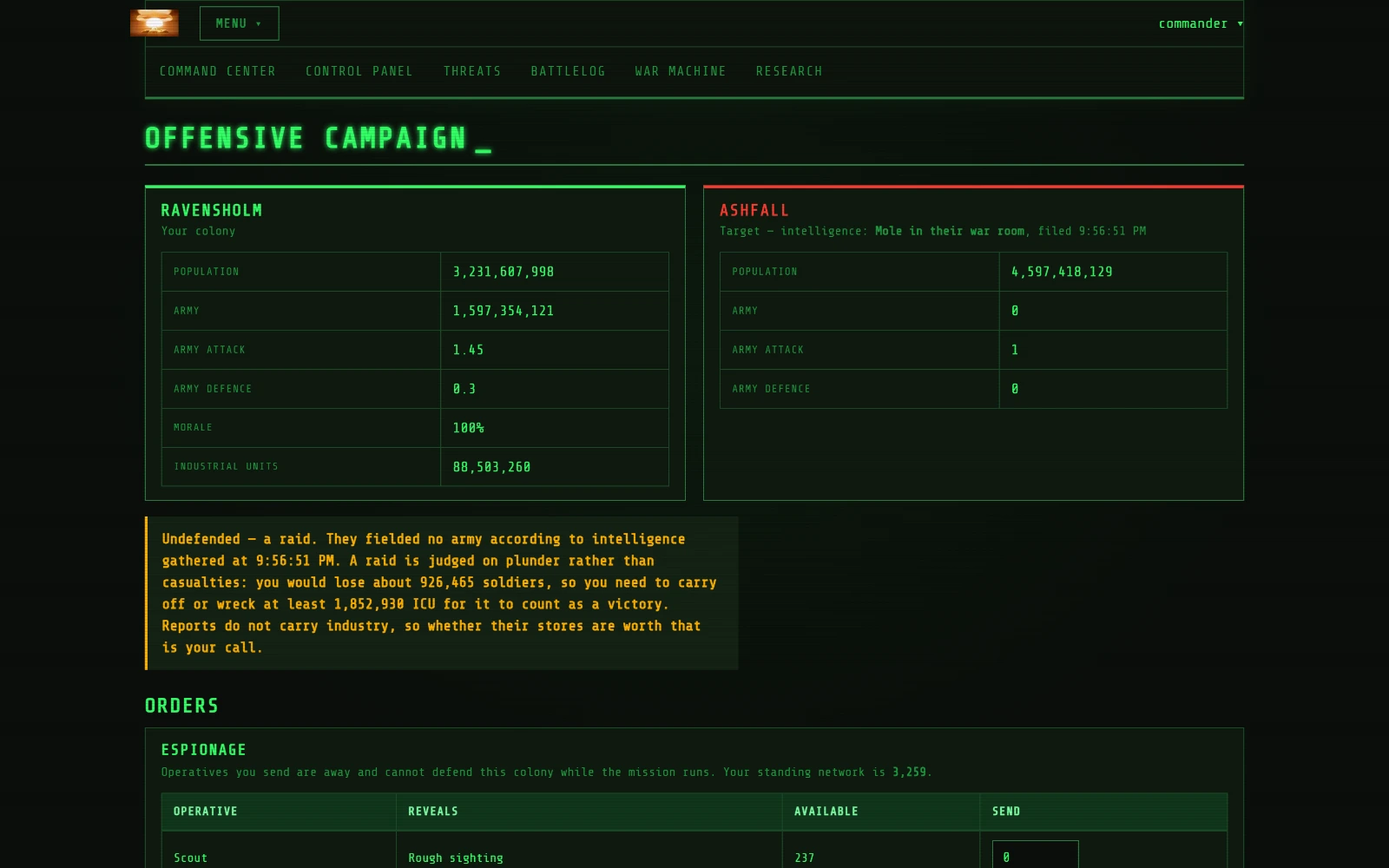
A campaign against Ashfall. Their exact figures are on the board only because a Mole put them there — and an undefended target is judged on what you carry off, not what you kill. 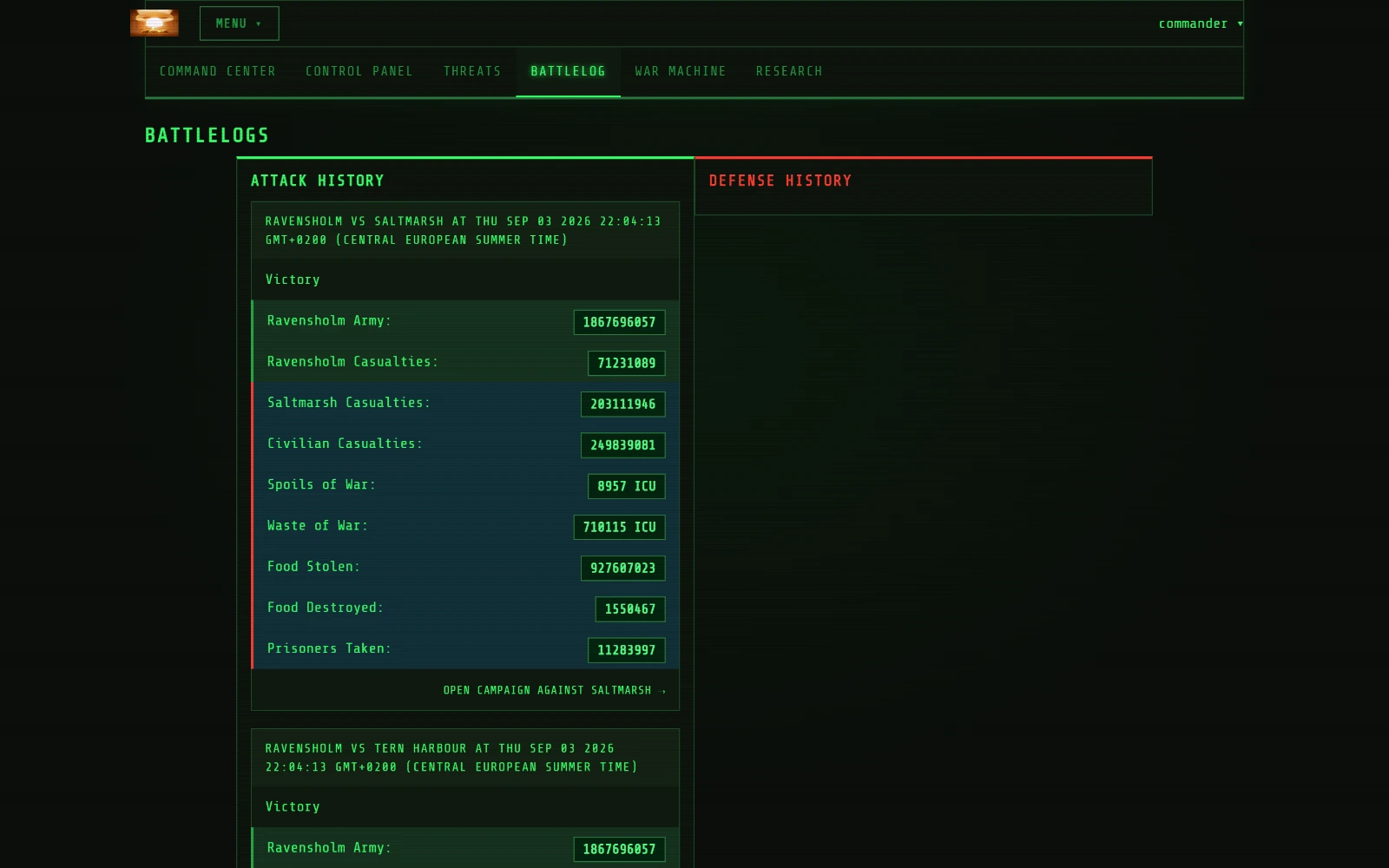
The Battlelog. Every engagement recorded on both sides of the ledger, down to the prisoners taken — and the only place a rival's real army size is ever written down.
Details
- Genre
- Persistent strategy
- Players
- Massively multiplayer
- Platforms
- Browser, desktop and mobile
- Status
- In development